Fire Science Show – Hot Smoke Testing
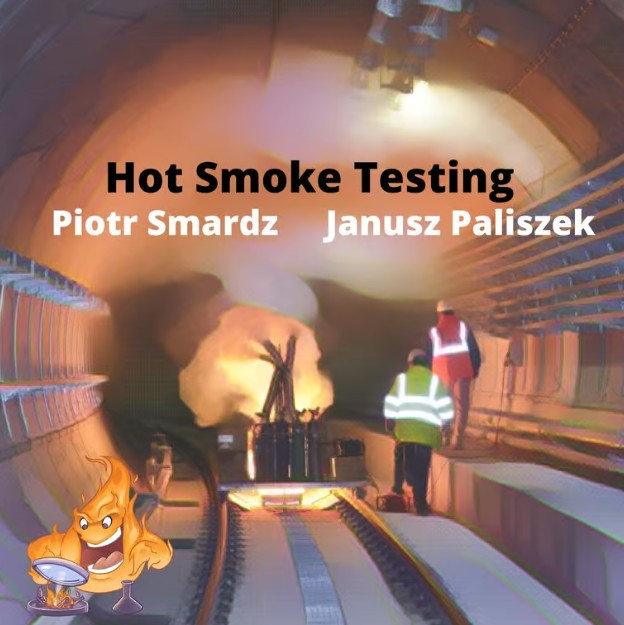
Hot smoke testing tends to split opinion. In some countries it’s dismissed as “theatre” an impressive demonstration that can’t possibly represent a real fire. In Poland (and elsewhere), it’s treated as a practical engineering tool that repeatedly uncovers real-world commissioning issues that desk checks and device-by-device testing often miss.
In Episode 33 of the Fire Science Show, host Wojciech Węgrzyński is joined by Piotr Smardz and Janusz Paliszek (INBEPO) to explore why the method is controversial, what it can do exceptionally well, and how the so called “Polish method” evolved into a fast, repeatable way to stress test real buildings.
Why the debate exists
The criticism is understandable – a hot smoke test is not a full scale design fire. You’re not recreating a multi-megawatt scenario inside a near complete building. But the episode makes an important point, if the goal is to prove extraction sizing for the maximum design fire, hot smoke testing is the wrong tool. That’s the job of engineering calculations and modelling.
Where hot smoke testing earns its reputation is elsewhere. It can expose how the real, installed system behaves when multiple building systems respond together, detection, cause and effect logic, dampers, fans, jet fans, smoke curtains, doors / gates, pressurisation and make-up air routes.
One of the strongest takeaways from the episode is the emphasis on simplicity and repeatability. The set-up (in principle) is straightforward:
- A controlled heat source to create a buoyant thermal plume (often alcohol trays, but other controlled sources are discussed)
- A visible white smoke tracer introduced into that plume so you can observe layer formation, spill plumes and smoke movement
- Recording, observation and selected measurements, video, notes and airflow / pressure checks – so the team can review what happened across a large area
The engineering part isn’t the smoke itself, it’s what happens next e.g. how quickly the building detects, what logic it applies, what opens / closes, what ramps up, what fights what, and where the smoke actually goes.
What hot smoke tests are particularly good at finding
Episode 33 highlights the kinds of problems that become obvious when you create a realistic, buoyant plume and introduce smoke into a live building scenario, including:
- Make-up air issues (especially high inlet velocities or poorly located inlets) that disrupt buoyancy and destroy clean smoke layers
- Leaky or incomplete smoke boundaries (curtains that leak, boundaries that aren’t deep enough, unexpected pathways via shafts and voids)
- Incorrect fan direction / jet fan orientation and momentum effects that push smoke the wrong way
- Cause-and-effect / matrix errors that only show up when multiple detectors activate and scenarios interact
- System interaction problems when components that “work” individually behave differently when they operate together
This is one reason hot smoke testing can be such a powerful commissioning reality check: smoke is unforgiving. If airflow paths, timing, or boundaries are wrong, you see it immediately.
Not a replacement for CFD – a complement (and a learning tool)
A theme running through the conversation is that hot smoke testing and CFD can strengthen each other when used correctly. Rather than trying to “prove” a design fire with a smaller test fire, teams can use hot smoke tests to:
- Verify that the installed system behaves as intended (logic, sequencing, boundaries, airflow paths)
- Sanity-check assumptions by running a test fire sized scenario in the model and comparing patterns qualitatively
- Build better engineering intuition by seeing real smoke behaviour (spill plumes, entrainment, mixing, layer disruption)
The episode also frames hot smoke testing as an unexpectedly effective education tool for everyone involved: designers, contractors, commissioning teams and stakeholders who rarely get to observe smoke movement at full scale. That learning tends to carry into future projects.
Where Concept Smoke fits in
Although this episode doesn’t focus on specific brands of equipment, it describes a testing approach that depends on a few essentials. A reliable, repeatable smoke source, strong visibility for video / observation, and practical output that can challenge a zone without requiring a “real fire”.
At Concept Smoke, we design and manufacture high-output smoke generators used globally for this very application. If your team is planning a hot smoke testing programme (car parks, malls/atria, transport infrastructure, tunnels, complex multi-zone buildings), we’re happy to share practical guidance on smoke generation set-ups, consumables, and how to get clean, repeatable results for observation and documentation
Listen to the episode
You can find Episode 033 on the Fire Science Show website, and via major podcast platforms.
Listen on Apple Podcasts:
Listen on Spotify:
Equipment used: