Artificial Smoke for HSG258 LEV Testing: Why Colt 4 and Air Trace Matter
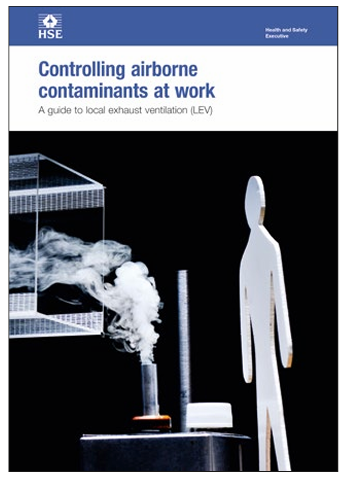
When people search for “HSG258 standards”, they are usually looking for practical guidance on how to prove that a local exhaust ventilation system is actually working. Strictly speaking, HSG258 is HSE guidance rather than a British Standard, but it is highly influential because HSE states that inspectors may refer to it and that following the guidance will normally mean you are doing enough to comply with the law.
HSG258 is aimed at employers, LEV suppliers and others involved in the design, commissioning, testing and maintenance of LEV systems. That matters because LEV performance is not just about a fan running or a pressure reading looking reasonable.
HSG258 is clear that effective LEV is about controlling real contaminant clouds before people breathe them in. The guidance covers design, commissioning, user manuals, logbooks, thorough examination and test, and the need to demonstrate that control is actually being achieved in practice.
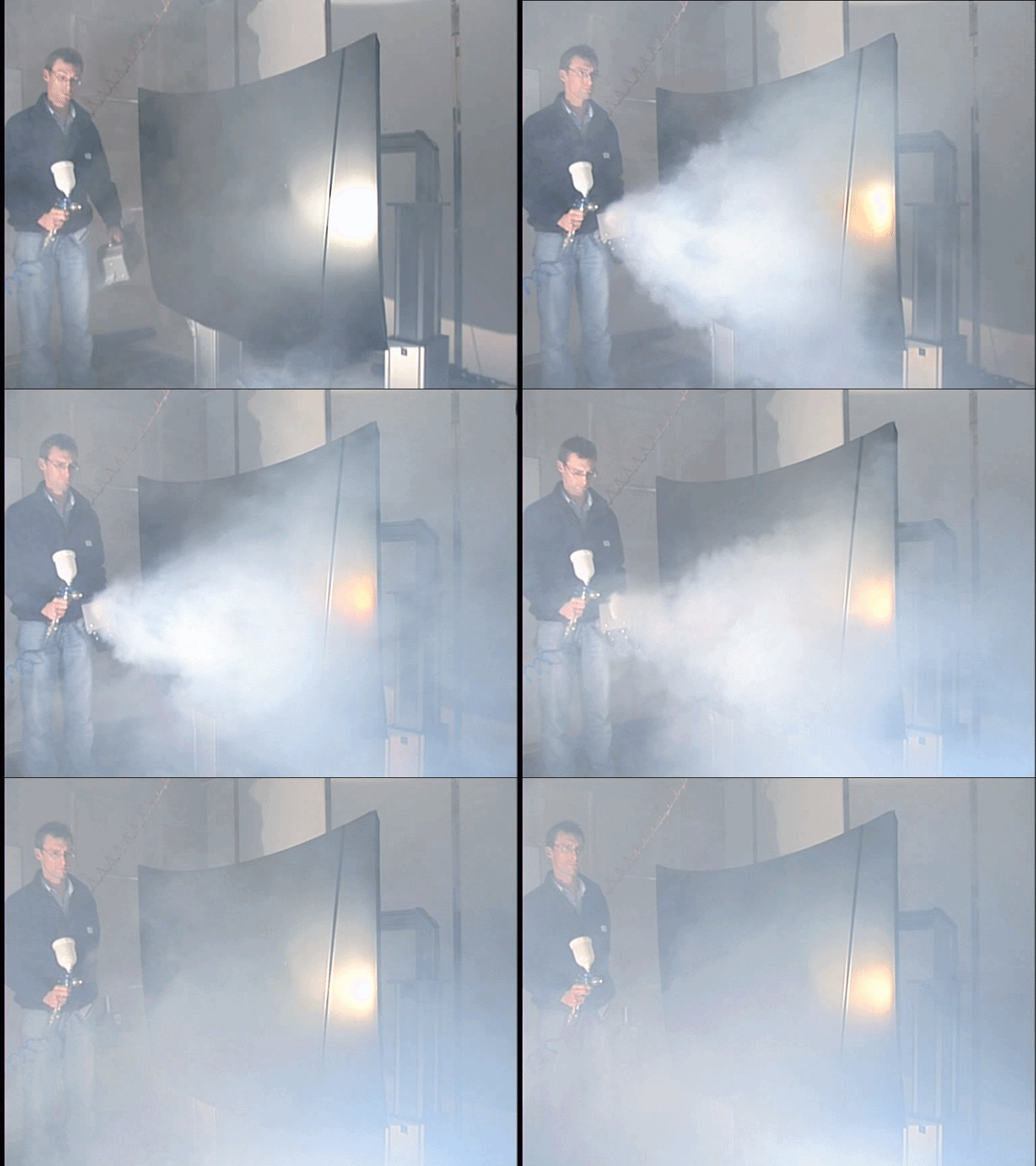
This is exactly where artificial smoke becomes valuable. HSG258 recognises that many airborne contaminants are partly visible or completely invisible, and specifically says smoke can be used to reveal the shape, size, speed and direction of an airborne cloud. It also says smoke from pellets, tubes or smoke generators can show capture zones, confirm containment within a hood, identify draughts, and show the general movement of air.
Why artificial smoke is so important under HSG258
A core problem in LEV work is that what an operator can see is often not the whole story. HSG258 explains that respirable particles can be practically invisible to the naked eye, and that dutyholders should understand the full extent of a contaminant cloud, not just the visible portion. The guidance even notes that releasing smoke into a cloud can reveal its true movement and boundaries.
The guidance also advises dutyholders to use observation and simple methods such as smoke or a dust lamp when assessing exposure control effectiveness, with measurements such as air sampling used where necessary. In other words, smoke is not a gimmick and it is not just for demonstrations. Under HSG258, smoke is a legitimate and useful tool for assessing how air actually behaves around a source, hood and operator.
HSG258 goes further by placing smoke directly into the commissioning and assessment process. It states that commissioning includes demonstrating the control of contaminant clouds and recording qualitative and quantitative findings as future benchmarks. It also makes clear that measurements alone do not provide direct evidence of control effectiveness. That is a crucial point: airflow numbers matter, but so does seeing whether the hood captures and contains the cloud in the real working environment.
Where smoke fits into LEV compliance
For most LEV systems, the maximum interval between thorough examinations and tests is 14 months, although some higher-risk processes require more frequent testing. HSG258 says a thorough examination and test should be carried out by a competent person and should assess both technical performance and control effectiveness. It also says employers should have a user manual and logbook for the system.
So in practice, good LEV compliance is not just a one-line airflow certificate. It is a combination of design intent, technical measurements, observation of working practice, and visual proof that the contaminant cloud is being controlled. Artificial smoke helps bridge the gap between what the paperwork says and what the air is actually doing.
What defines a competent person for LEV testing?
Under HSE guidance, including HSG258, a thorough examination and test (TExT) of local exhaust ventilation (LEV) systems should be carried out by a “competent person.” Rather than defining competence by a single qualification, HSE guidance generally points towards a combination of knowledge, experience, training and the ability to apply informed judgement to the specific system and process being assessed.
A balanced combination of knowledge and experience
In the context of LEV, a competent person would typically be expected to demonstrate:
- Technical understanding of LEV system design, including hoods, airflow behaviour, ducting, fans and filtration.
- Practical testing experience, including measurement techniques, system inspection and fault identification.
- Awareness of the process and hazard, such as dusts, fumes, vapours or mists, and how these influence system performance.
- The ability to assess control effectiveness in practice, not just whether a system is operating, but whether it is actually capturing and controlling airborne contaminants.
This often involves combining measured data with real-world observation, including airflow visualisation techniques such as artificial smoke.
The importance of training and recognised qualifications
While competence is broader than any single certificate, recognised industry training plays an important role in developing and demonstrating capability. Courses such as BOHS P601 (Thorough Examination & Testing of LEV systems) are widely respected within the industry and provide structured training in:
- LEV principles and system performance.
- Measurement methods and interpretation.
- Identification of defects and performance issues.
- Reporting requirements and good practice.
Training of this kind helps build a solid technical foundation and is often viewed as a strong indicator that an individual has been formally introduced to accepted LEV testing methodologies. However, as reflected in HSE guidance, training is typically most effective when combined with relevant practical experience, particularly where systems are complex or processes vary.
Judgement, not just measurement
A key aspect of competence is the ability to move beyond simply recording readings. A competent assessment will usually consider:
- How the system performs under normal working conditions.
- How operator behaviour influences exposure.
- Whether draughts or surrounding processes affect performance.
- Whether contaminants are being effectively captured and contained.
This is why visual tools such as smoke testing are often used alongside instrumentation – helping to provide a more complete and practical understanding of system performance.
A practical definition, In simple terms:
A competent person for LEV testing is someone who understands how the system is intended to work, can assess how it performs in real conditions, and can make a reliable judgement on whether it is effectively controlling airborne contaminants. This typically involves a combination of:
- technical knowledge
- hands-on experience
- recognised training (such as BOHS P601)
- and practical observation
Case study scenario 1: Colt 4 for spray booth clearance testing and large-volume LEV visualisation
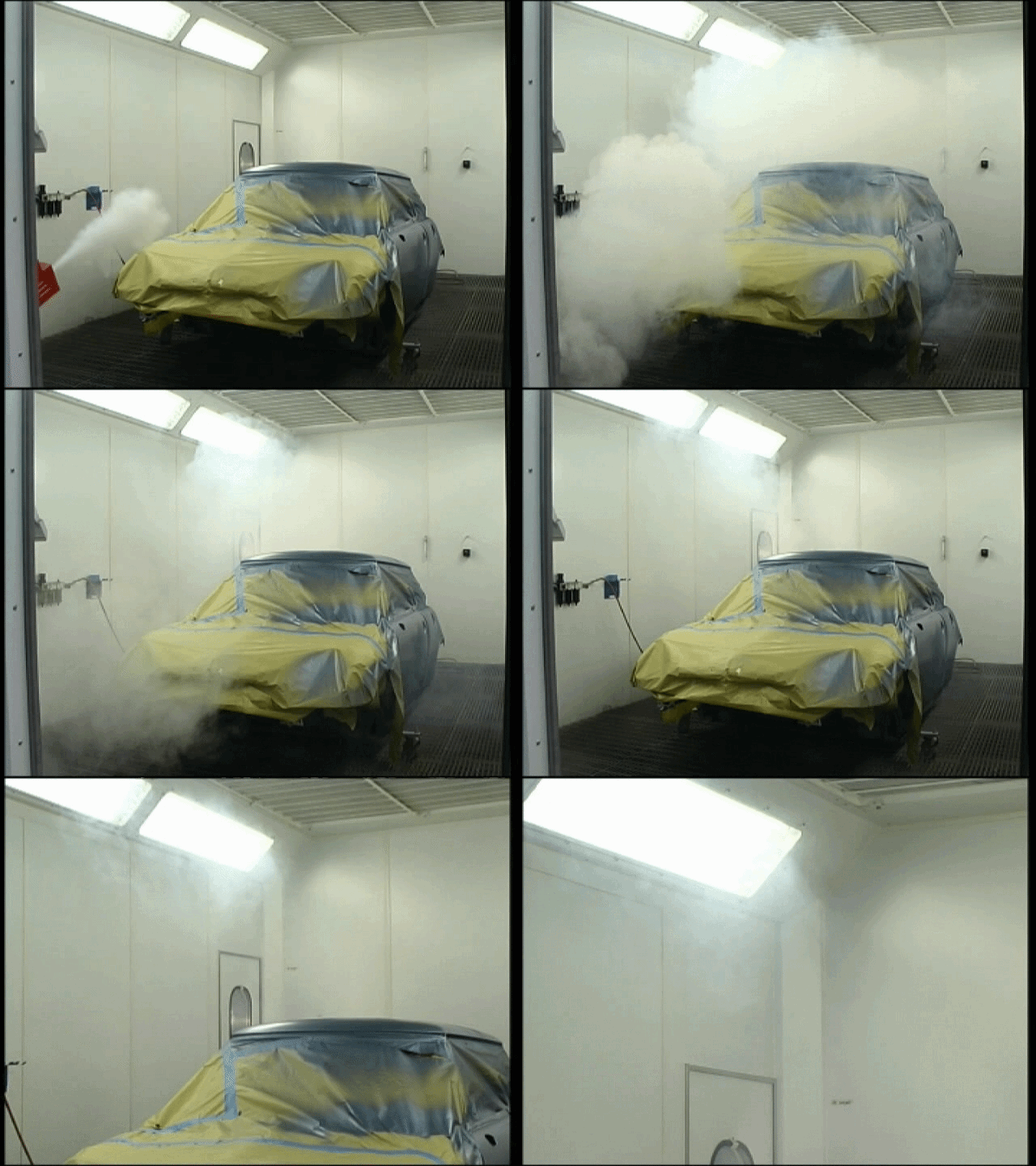
One of the clearest real-world uses of artificial smoke in the HSE framework is spray booth clearance time testing. HSE’s own bodyshop guidance describes a procedure for measuring clearance time using a professional smoke machine. The booth is filled with smoke, the extraction is switched on, and the time taken to clear the room is recorded and then displayed for users. HSE recommends that this clearance time test forms part of the booth’s thorough examination and test.
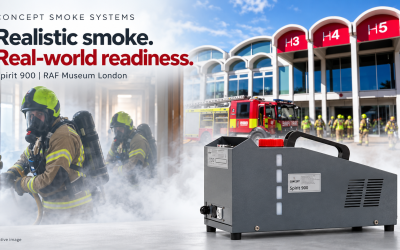
This is a perfect example of where the Concept Colt 4 comes into its own. The Colt 4 is a powerful handheld generator designed for air flow visualisation and spray booth clearance tests, producing a highly persistent smoke and off-power capability after preheating. The Colt 4 also produces a very fine particle size and is intended for applications where dense smoke concentrations or smoke logging of larger volumes are required.
For large booths, cabins and enclosing hoods, persistence matters. HSG258 says smoke generators can produce variable amounts of smoke for prolonged periods and are useful for assessing the effectiveness of large enclosing hoods. That makes them materially different from small smoke tubes, which HSG258 says are often more useful for smaller hoods. In other words, the guidance itself supports matching the smoke source to the size and duty of the test.
A typical spray booth workflow under HSE guidance is straightforward: fill the booth with smoke, distribute it evenly, start the extraction, watch how the smoke clears, inspect for leakage and note the clearance time. In that scenario, the value of a persistent, portable machine is obvious. The smoke has to remain visible long enough to expose dead spots, eddies, wall effects, leakage points and slower-clearing zones. HSE also notes that smoke tends to linger near booth walls, which is exactly the kind of behaviour that a well-chosen smoke generator helps make obvious.
The Colt 4 produces a highly persistent smoke, which is essential for accurate spray booth clearance testing. In contrast, typical theatrical or party fog machines generate a short-lived visual effect that dissipates rapidly, often within seconds. This limits their usefulness in identifying stagnation zones and can lead to misleading conclusions about the effectiveness of the extraction system.
The Colt 4 is commonly used by the HSE, HSL other major inspection bodies. Indeed in 2006 the HSL conducted in depth review into a variety of commercially available smoke generators and concluded that “the Colt 4 Turbo machine was superior in performance to the cheaper units tested in this study; it produced the most smoke in a given time; produced the thickest smoke; and was capable of smoke production when disconnected from the mains” (“Review of commercially available party fog machines suitable for determining the clearance time of paint spray booths and rooms HSL/2006/43).
Why the Colt 4 fits HSG258 applications so well
The Colt 4 is well suited when the question is not just “is air moving?” but “is this large volume actually clearing properly, and where is it failing?” Its use case aligns neatly with HSG258’s description of smoke generators for prolonged smoke production and assessment of large enclosures, and with HSE’s own spray booth clearance methodology.
That makes it particularly relevant for:
- spray booth and spray room clearance time checks
- walk-in booths and partial enclosures
- large receiving or enclosing hoods
- leakage checks around ducting, doors and booth fabrications
- visualisation of draught interference and air short-circuiting
Case study scenario 2: Air Trace MK2 for local airflow patterns, capture zones and fine LEV diagnostics
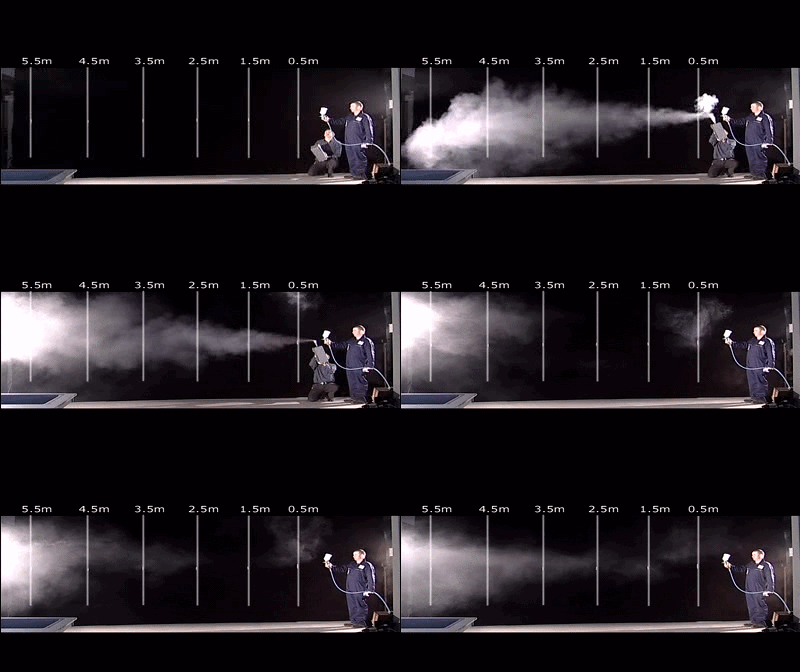
At the other end of the scale is the Concept Air Trace MK2. Where the Colt 4 is about persistence and larger-volume visualisation, the Air Trace is designed for small, localised airflow tracing. It’s a battery-powered handheld unit with instant heat-up, smooth low output and suitability for tracing local airflow patterns. The resulting smoke effect is designed to disperse quickly, making it useful where the goal is to observe local air movement without flooding the area.
This aligns closely with smaller-scale HSG258 tasks. The guidance says smoke can identify capture zones and boundaries, confirm containment and reveal draughts. For those tests, a huge, lingering smoke load can actually be less useful than a smaller, controlled stream that lets the examiner look precisely at what happens near the hood face, source or operator breathing zone.
The Air Trace can produce a steady smoke stream for around 15–20 minutes from a fully charged Pb battery (30 minutes using the upgraded NiMH), and that its fluid is formulated to create a clearly visible smoke that naturally evaporates in about 60–90 seconds. That makes it a strong fit for applications such as:
- small capture hoods
- bench-top LEV checks
- local draught tracing near doors, windows or cooling fans
- cleanroom or controlled-environment airflow visualisation
- confirming whether smoke is entering a hood or escaping into the workspace
In practical HSG258 terms, Air Trace is the machine for the question: “What is this local airstream doing, right here, right now?” If an operator is leaning slightly outside a partial enclosure, if a cross-draught is peeling a cloud away from the hood, or if a small canopy is failing at the edges, a low-output handheld tracer can often show that more clearly than a high-output booth-filling machine.
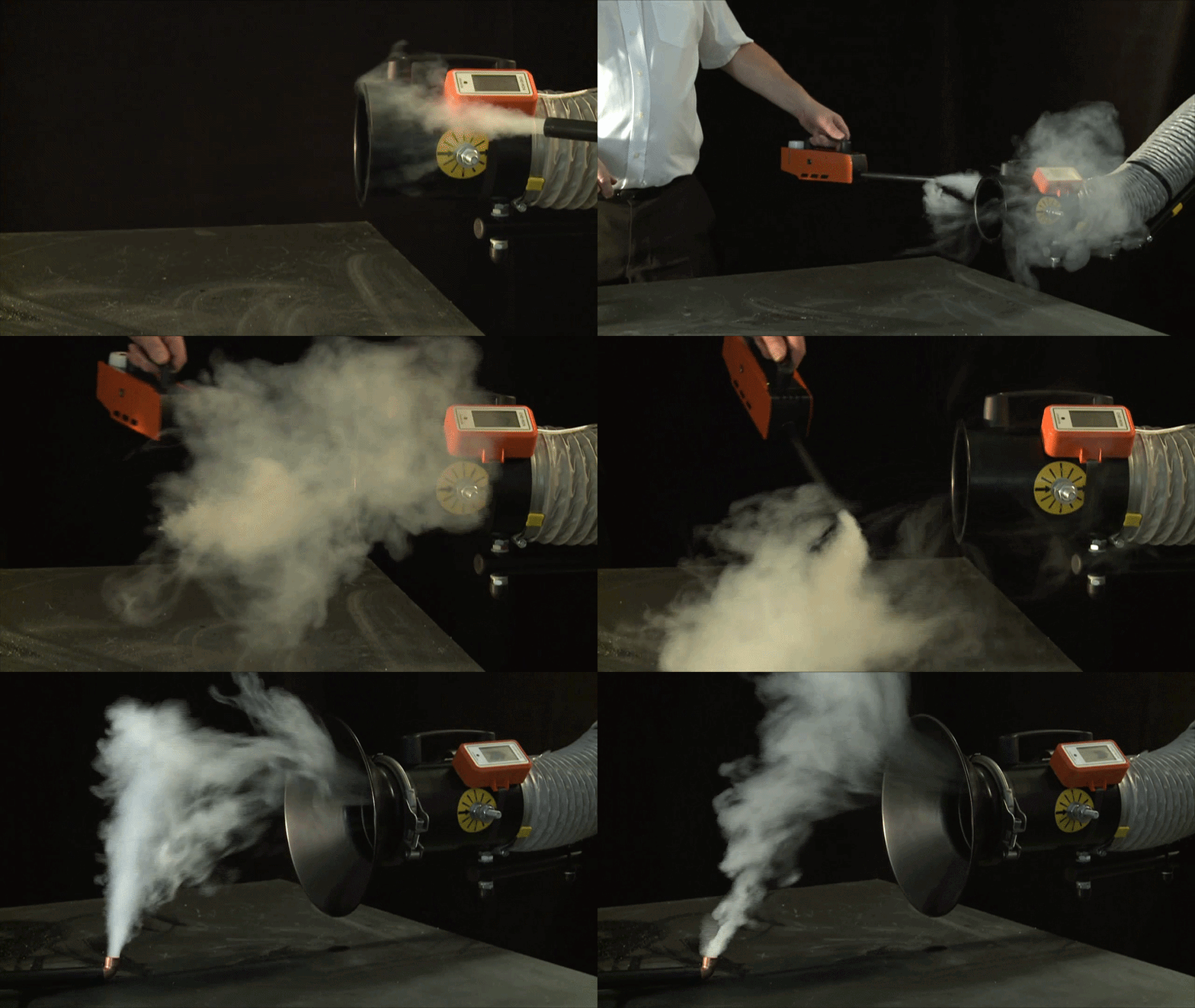
The real compliance value: smoke makes defects visible
HSG258 highlights several ways hood effectiveness can be reduced, including flow separation, recirculatory eddies, turbulence and draughts. It also notes that draughts can come from nearby processes, cooling fans, open doors, windows, vehicle movement and poor make-up air. These are exactly the kinds of defects that may not be obvious from a static pressure reading alone but become immediately visible with smoke.
This is why smoke is so useful in client demonstrations, commissioning visits and statutory re-tests. It helps answer the questions that matter operationally:
- Is the cloud entering the hood, or rolling back into the operator’s face?
- Is the enclosure containing the emission, or leaking from the opening?
- Is the general room airflow helping capture, or fighting it?
- Are there dead zones where contaminants remain suspended after the process stops?
Why particle size and neutral buoyancy matter in airflow visualisation
When using artificial smoke for LEV assessment, the quality of the smoke itself is just as important as the quantity. Two of the most important characteristics are particle size and neutral buoyancy.
To be useful in airflow visualisation, smoke needs to respond to air movement in a way that is representative and easy to observe. If the particles are too large or heavy, they may fall out of suspension too quickly or behave more like a visible mist than a true airflow tracer. A fine particle size helps the smoke remain suspended for longer and follow subtle air currents more accurately.
This is particularly important when assessing:
- capture zones around LEV hoods
- low-velocity airflow patterns
- draught interference
- stagnation areas within booths or enclosures
- the true direction of air movement around the operator
In practical terms, finer smoke makes it easier to see whether air is genuinely being drawn into the extraction point, or whether it is drifting, recirculating or escaping into the surrounding workspace.
Neutral buoyancy is also a key requirement in effective smoke testing. In simple terms, this means the smoke should have as little natural tendency as possible to rise rapidly through heat or fall due to weight. Instead, it should move primarily in response to the surrounding airflow. This is important because the objective of the test is to visualise what the air is doing, not what the smoke would do under its own weight or thermal lift.
If a smoke is too buoyant, it may rise unnaturally and give a misleading impression of airflow direction. If it is too heavy, it may sink or drop out too quickly, again distorting the results. A smoke with near-neutral buoyancy is therefore far more useful for showing:
- true airflow paths
- areas of containment or escape
- dead spots and eddies
- extraction effectiveness in real operating conditions
Why this matters in LEV and spray booth testing
In applications such as spray booth clearance testing and local exhaust ventilation diagnostics, the aim is not simply to create a dramatic visible cloud. The aim is to generate a smoke that behaves in a stable, predictable and representative way so that the user can make a reliable judgement about system performance. This is one of the reasons purpose-designed airflow visualisation equipment is generally more suitable than generic theatrical fog machines. A machine intended for compliance-led testing needs to produce smoke with characteristics that allow it to stay visible, remain suspended appropriately, and follow air movement faithfully.
Particle size, efficiency and cleanliness
HSE guidance does make reference to the potential for residue following smoke tests. That is a fair and sensible point in principle, as any smoke-based test has the potential to leave some trace depending on the type of smoke used, the concentration generated and the environment in which it is deployed.
In practice, however, when the Concept Colt 4 or Air Trace MK2 are used correctly and in accordance with their operating instructions for this type of airflow visualisation or clearance test, the likelihood of finding any measurable or quantifiable residue after a single test is extremely low. This is due in large part to the very fine particle size produced by these systems, typically in the region of ~0.2–0.4 µm, compared with a more typical theatrical or party fog machine, which may produce particles closer to ~2 µm.
Although that difference may appear small at first glance, it has a very significant effect on how the smoke behaves in air. Assuming unit density, a 0.2 µm particle has a settling velocity of approximately 8 mm per hour, whereas a 2 µm particle settles at approximately 468 mm per hour. In practical terms, this means the much finer particles produced by the Colt 4 and Air Trace MK2 remain suspended far more effectively and achieve the required visible effect using significantly less fluid overall.
The result is a cleaner, more efficient smoke effect, with lower fluid consumption and a much lower likelihood of noticeable deposition on surrounding surfaces under normal test conditions. It is for this reason that the Colt 4 and Air Trace MK2 have earned a reputation as being among the cleanest smoke generators available for professional airflow visualisation and LEV testing.
Do HSE inspectors use Colt 4 and similar equipment?
The careful answer is this: Concept states on its LEV application page that HSE, HSL and other inspection bodies routinely use the Colt 4 for airflow visualisation and LEV-related assessments. I have not found an HSE page that independently names the Colt 4 brand, so the safest wording for publication is to attribute that statement to Concept rather than present it as a directly verified HSE declaration.
That said, HSE’s own guidance unquestionably supports the broader method. HSG258 explicitly endorses smoke for making air movement visible, and HSE’s bodyshop guidance explicitly uses smoke machines for clearance-time testing. So even without a brand-specific HSE endorsement page, the use of artificial smoke as part of LEV assessment is fully consistent with HSE practice and guidance.
Best practice for using artificial smoke in HSG258 LEV work
For companies carrying out LEV testing, commissioning or compliance reviews, the strongest approach is to treat smoke as part of a structured evidence pack, not as a standalone visual demo. That means combining smoke observations with airflow readings, system checks, user observations, and proper documentation in the commissioning report, user manual and logbook.
HSG258 repeatedly emphasises the value of recording qualitative and quantitative findings as future benchmarks. In practice, that usually means:
- selecting the right smoke source for the scale of the test;
- testing with the process and operator position represented realistically;
- checking draughts, leakage and containment, not just “does the smoke move”;
- recording photos, video and written observations;
- linking those findings back to the LEV report and corrective actions.
Conclusion
Artificial smoke is one of the most practical ways to turn HSG258 from theory into visible proof. The guidance is clear that smoke has a real role in showing contaminant cloud behaviour, capture zones, containment and draught effects. It also makes clear that LEV compliance is about control effectiveness, not just airflow numbers.
For large enclosures, spray booths and persistent visualisation, the Colt 4 is a strong fit because it is built for dense, durable smoke and portable use during real-world testing. For local airflow tracing, small hoods and quickly dispersing visualisation, the Air Trace is better suited because it gives a controlled, low-output stream without overloading the space. Used properly, both tools help dutyholders, engineers and inspectors see exactly what HSG258 is trying to control: the movement of airborne contaminants before they reach the worker.
FAQs
What is HSG258?
HSG258 is the HSE guide to local exhaust ventilation. It provides practical guidance on designing, commissioning, using, maintaining and testing LEV systems to control airborne contaminants at work.
Is smoke testing recognised in HSG258?
Yes. HSG258 recognises smoke as a useful way to visualise airflow, capture zones, containment and draught interference in LEV systems.
What is the Colt 4 used for?
The Colt 4 is commonly used for spray booth clearance testing, larger enclosure airflow visualisation, extraction pattern checks and broader LEV diagnostic work.
What is the Air Trace used for?
The Air Trace is used for smaller-scale airflow tracing, local hood assessment, draught detection and point-of-use LEV diagnostics.
Why use artificial smoke for LEV testing?
Artificial smoke makes invisible airflow visible, helping engineers and inspectors identify problems that may not be obvious from measurements alone.
Do inspection bodies use this type of equipment?
Yes. Concept equipment, including the Colt 4, is used in professional inspection and airflow assessment work, including by HSE inspectorate teams.
Need a professional smoke generator for HSG258 LEV testing, airflow visualisation or spray booth clearance checks?
Products Used:
You can buy the book at https://books.hse.gov.uk/ (ISBN 978 0 7176 6613 3).
You can download web-friendly version of HSG258 (Third edition, published 2017) Controlling airbornecontaminants at work: A guide to local exhaust ventilation (LEV) HSG258