The Genie That Won’t Retire, Concept’s Smoke-Making Past, Rediscovered
In 1969, the world was preparing to put a man on the Moon. At White Waltham Airfield in Maidenhead, Concept Engineering was busy making it harder to see across the room.
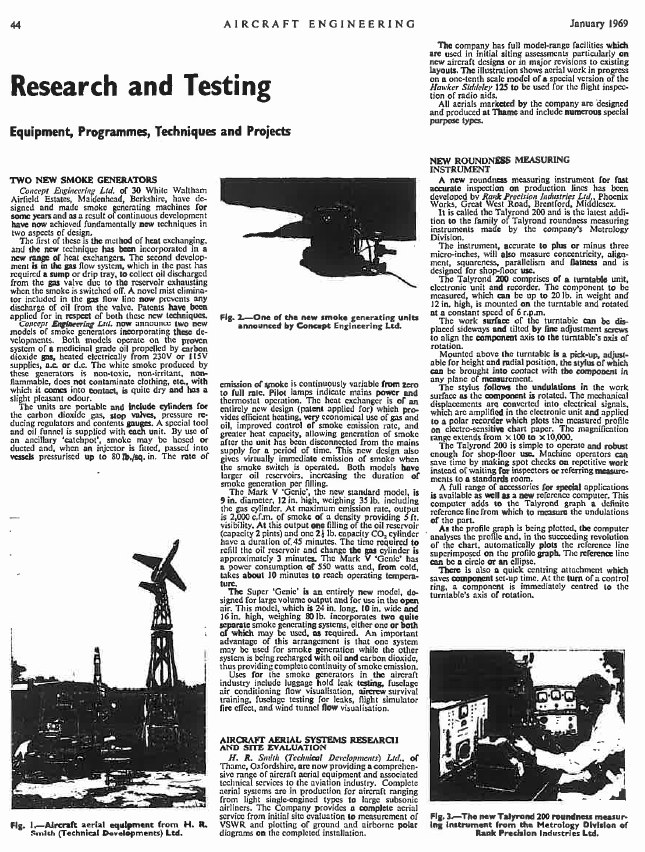
We’ve uncovered the oldest public article we’ve found so far relating to the Concept MKV Genie, a January 1969 feature in Aircraft Engineering, now held in Emerald Publishing’s archive. Tucked into the journal’s “Research and Testing” section, under the wonderfully straightforward heading “Two New Smoke Generators”, is a little piece of Concept history.
And the best part? Some of our customers are still using MKV Genies today.
Plenty of products from that era have earned a comfortable retirement behind museum glass. Some of our Genies apparently haven’t received the memo.
The article places Concept Engineering Ltd at 30 White Waltham Airfield Estates and explains that the company had already been designing and making smoke generating machines for several years. Even in 1969, this was an established engineering business refining its technology.
The developments making the news were a new heat exchanger design and an improved gas flow system. The report describes more effective heating, better control of smoke output, greater stored heat and a mist eliminator to prevent oil escaping through the gas valve when the machine was switched off. Practical improvements aimed at making a working machine work better.
The Mark V “Genie” was the standard model, just nine inches in diameter and twelve inches high, weighing 35lb including its gas cylinder. It used a 550 watt heater and took around ten minutes to warm up from cold. The published maximum output was 2,000 cubic feet per minute, at a smoke density giving five foot visibility. That visibility detail is a pleasing reminder that even a vintage specification deserves a proper read beyond the headline number.
Alongside it was the larger Super Genie, designed for higher volume output and outdoor use. It contained two separate smoke generating systems, allowing one to keep working while the other was replenished. Clearly, stopping for a breather was not part of the brief.
The applications sound remarkably familiar: aircraft leak testing, air-conditioning flow visualisation, aircrew survival training, flight simulator fire effects and wind-tunnel studies. More than half a century later, helping people see airflow and recreate reduced visibility conditions remains central to what we do.
The MKV went on to serve customers in special effects, fire training and aircraft simulation. Production ended in 1995, but machines remain in use, with a particularly loyal following in Japan. Even the last examples produced are now more than thirty years old. That is a respectable working life by anyone’s standards. Read more about the Genie and Concept’s history in our 60-year anniversary feature.
For us, the appeal of this discovery goes beyond nostalgia. It puts a date, a name and a set of engineering ideas on the page, connecting the business we run today with the people building smoke machines at White Waltham all those years ago.
If you still have a Genie in service, we’d love to see it. Send us a photograph, its serial number and a little about what it does. There may be a few more chapters of Concept history quietly getting on with the job.
Fifty seven years after this article appeared, it seems some Genies still have no intention of going back into the bottle.
Archive source: “Research and Testing”, Aircraft Engineering and Aerospace Technology, Vol. 41, No. 1, p. 44, January 1969, subsection “Two New Smoke Generators”. Permanent reference.
Transcription of the relevant 1969 section
Transcribed from page 2 of the supplied PDF (printed page 44). Line-break hyphenation has been joined and typography lightly normalised. This is the Concept section and its associated caption, excluding the unrelated aerial-equipment and roundness-measurement articles. Historical performance and safety wording is reproduced as printed, not presented as current guidance.
TWO NEW SMOKE GENERATORS
Concept Engineering Ltd. of 30 White Waltham Airfield Estates, Maidenhead, Berkshire, have designed and made smoke generating machines for some years and as a result of continuous development have now achieved fundamentally new techniques in two aspects of design.
The first of these is the method of heat exchanging, and the new technique has been incorporated in a new range of heat exchangers. The second development is in the gas flow system, which in the past has required a sump or drip tray, to collect oil discharged from the gas valve due to the reservoir exhausting when the smoke is switched off. A novel mist eliminator included in the gas flow line now prevents any discharge of oil from the valve. Patents have been applied for in respect of both these new techniques.
Concept Engineering Ltd. now announce two new models of smoke generators incorporating these developments. Both models operate on the proven system of a medicinal grade oil propelled by carbon dioxide gas, heated electrically from 230V or 115V supplies, a.c. or d.c. The white smoke produced by these generators is non-toxic, non-irritant, non-flammable, does not contaminate clothing, etc., with which it comes into contact, is quite dry and has a slight pleasant odour.
The units are portable and include cylinders for the carbon dioxide gas, stop valves, pressure reducing regulators and contents gauges. A special tool and oil funnel is supplied with each unit. By use of an ancillary ‘catchpot’, smoke may be hosed or ducted and, when an injector is fitted, passed into vessels pressurised up to 80 lb./sq. in. The rate of emission of smoke is continuously variable from zero to full rate. Pilot lamps indicate mains power and thermostat operation. The heat exchanger is of an entirely new design (patent applied for) which provides efficient heating, very economical use of gas and oil, improved control of smoke emission rate, and greater heat capacity, allowing generation of smoke after the unit has been disconnected from the mains supply for a period of time. This new design also gives virtually immediate emission of smoke when the smoke switch is operated. Both models have larger oil reservoirs, increasing the duration of smoke generation per filling.
The Mark V ‘Genie’, the new standard model, is 9 in. diameter, 12 in. high, weighing 35 lb. including the gas cylinder. At maximum emission rate, output is 2,000 c.f.m. of smoke of a density providing 5 ft. visibility. At this output one filling of the oil reservoir (capacity 2 pints) and one 2½ lb. capacity CO₂ cylinder have a duration of 45 minutes. The time required to refill the oil reservoir and change the gas cylinder is approximately 3 minutes. The Mark V ‘Genie’ has a power consumption of 550 watts and, from cold, takes about 10 minutes to reach operating temperature.
The Super ‘Genie’ is an entirely new model, designed for large volume output and for use in the open air. This model, which is 24 in. long, 10 in. wide and 16 in. high, weighing 80 lb. incorporates two quite separate smoke generating systems, either one or both of which may be used, as required. An important advantage of this arrangement is that one system may be used for smoke generation while the other system is being recharged with oil and carbon dioxide, thus providing complete continuity of smoke emission.
Uses for the smoke generators in the aircraft industry include luggage hold leak testing, fuselage air conditioning flow visualisation, aircrew survival training, fuselage testing for leaks, flight simulator fire effect, and wind tunnel flow visualisation.
Fig. 2.One of the new smoke generating units announced by Concept Engineering Ltd.
Publication details from the PDF cover
- Article: Research and Testing
- Journal: Aircraft Engineering and Aerospace Technology
- Year: 1969
- Volume: 41
- Issue: 1
- Pages: 44–44
- Printed issue date: January 1969
- DOI: https://doi.org/10.1108/eb034473