Vapour Barrier (Vapor Barrier) & Membrane Inspections Using Artificial Smoke
Why smoke testing vapour barriers matters (and what it proves)
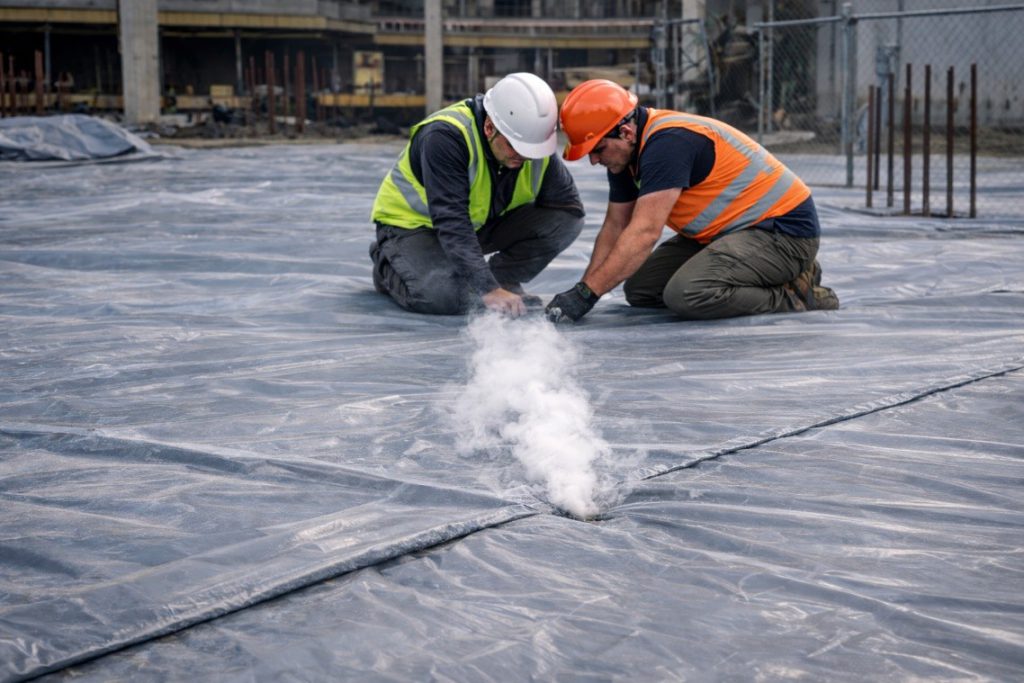
A vapour intrusion or waterproofing membrane can look perfect and still leak. The weak points are nearly always the details (e.g. seams, penetrations, terminations, and transition points, the areas most likely to be missed by visual inspection alone). Smoke testing (using artificial smoke) is popular in membrane QA/QC because it provides direct visual confirmation of leak paths – if smoke is pumped beneath the membrane and you see smoke emerging on the surface or at an edge detail, you’ve found a leak, the more smoke, the larger the leak.
What is “vapour barrier smoke testing”?
In practice, a smoke test is conducted by pumping non-toxic smoke underneath the vapour/vapor intrusion barrier and documenting where smoke escapes, so repairs can be completed immediately and the area re-tested.
Where smoke testing fits in a membrane QA/QC plan
Smoke testing is most commonly used for below-slab membranes and vapour intrusion systems, where it can quickly reveal small imperfections across large areas. A solid QA/QC plan typically combines:
- Visual inspection of seams, penetrations and terminations
- Smoke testing as the “whole system” verification step
- Documentation (photos, marked plans, leak logs) to evidence performance
Why artificial smoke works so well for leak detection
 Artificial smoke (fog) is effective because it:
- Moves with air pressure differentials and finds the path of least resistance
- Makes microscopic breaches visible, including pinholes and imperfect seals
- Allows instant repair and immediate retesting, reducing rework and downstream risk
For many projects, the value is simple, if you can find leaks before slab pour / cover-up, you avoid expensive investigation and remedial works later.
The equipment question: why output and persistency matter
On real sites, smoke testing succeeds or fails based on two practical realities:
- Can you generate enough smoke volume to reach every corner under the membrane?
- Does the smoke hang around long enough for teams to inspect and mark defects properly?
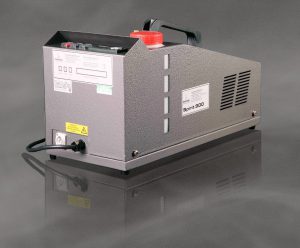
That’s where a high-output, continuously rated smoke generator and the right airflow toolset make a measurable difference. The Spirit 900 is designed for applications needing continuous, high smoke output, using a continuously rated pump and a precision heat exchanger approach.
Key attributes that translate directly to membrane testing:
1) Continuous output for full-area inspections
You can maintain stable production during the “inspect/mark/repair/re-test” cycle rather than relying on short bursts.
2) Persistent smoke options (critical for large membranes)
The Spirit 900 supports different fluids, including Smoke Fluid A for very persistent smoke / long hang time, and alternatives for quicker dispersal where needed.
3) Efficient consumption (lower running cost, fewer interruptions)
Excellent fuel efficiency means that just ~50ml/min of smoke fluid is used at maximum output, drawn from an integral 2ltr reservoir (optional larger external reservoir available) to keep the test moving.
4) Fine particulate smoke (helps visibility of small leaks)
Smoke particle mass median diameter around 0.2 micron.
5) Practical site features
Remote operation is included as standard, and the unit is primarily designed as a robust site tool rather than a theatrical smoke machine.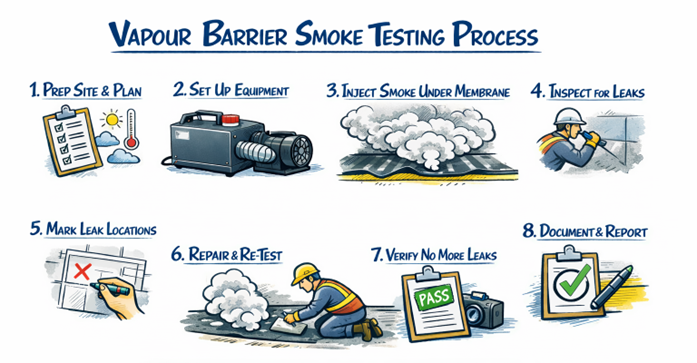
Why add a centrifugal fan (and when it becomes essential)
For vapour barrier inspections, the goal is usually high volume, low pressure distribution under the membrane. Enough to move smoke everywhere without “ballooning” the sheet or damaging details. A centrifugal fan/blower becomes especially valuable when you need:
- Long duct runs
- Smoke pushed into remote zones
- Fast distribution beneath large footprints
- Stable flow while the team inspects and repairs
Concept offer a range of centrifugal blowers of different capabilities to cater for a variety of applications.
Equipment used: