Spray Booth Clearance Testing: Why Smoke Persistence Matters
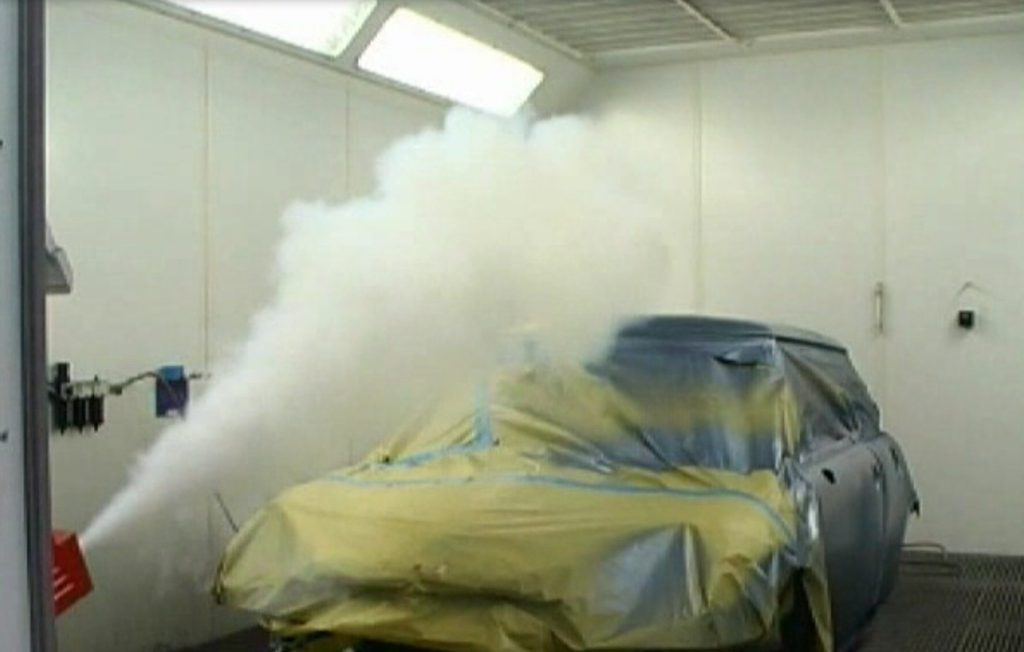
The HSE’s guidance on measuring spray booth clearance times highlights an essential part of assessing ventilation performance: establishing how long smoke remains after extraction begins. For anyone carrying out these tests, the choice of smoke generator and fluid matters.
At Concept Smoke Systems, we recommend the Colt 4 for its dense, persistent smoke and practical advantages in professional testing. Its performance is supported by independent HSL testing, which found the Colt 4 Turbo superior to the lower-cost fog machines assessed.
What is a clearance time test?
The HSE describes a procedure in which an empty spray booth or room is filled evenly with smoke while extraction is switched off. The ventilation is then started, and the time taken for visible smoke to disappear from every part of the space is recorded.
Crucially, the whole booth must be assessed. Smoke can linger near walls and circulate in eddies even after the main space appears clear. The HSE recommends testing shortly before filters are changed, helping establish clearance time under less favourable operating conditions. Read the HSE guidance on measuring clearance times.
Disappearing smoke does not necessarily mean effective extraction
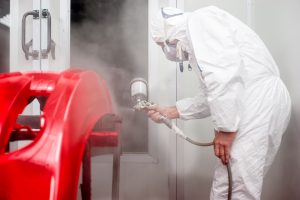
A clearance test relies on smoke remaining visible long enough to reveal how effectively the ventilation removes it.
If smoke evaporates faster than the extraction system removes it, the booth can appear clear prematurely. The recorded clearance time may then underestimate the time needed for ventilation to clear the space, creating a misleading impression of extraction performance.
This is particularly important when identifying areas of stagnation, where air moves slowly or recirculates. Short lived smoke may fade before these pockets become apparent. Persistent smoke makes them easier to follow, allowing the operator to see where clearance is delayed.
The aim is to observe smoke being removed by ventilation. A rapidly fading visual effect can undermine that observation.
Why the Colt 4 is a superior choice
The Colt 4 produces dense, persistent smoke suited to following air movement throughout a clearance test, unlike generic theatrical fog machines.
Its ability to produce smoke after being disconnected from the mains also allows operators to move around the booth and distribute smoke where needed. Together, persistence and portability make it particularly useful for professional inspection work. Find out more about Concept’s LEV and clearance testing equipment.
Independent evidence reinforces these advantages. In its 2006 report, Review of commercially available party fog machines suitable for determining the clearance time of paint spray booths and rooms, HSL compared six party fog machines with the Colt 4 Turbo.
The Colt 4 Turbo produced the greatest quantity of smoke in a given time, generated the thickest smoke and could operate disconnected from mains power. The report also identified professional equipment’s advantages when testing very large booths or numerous standard booths.
It specially advises against two models partly because their smoke thinned noticeably during the 20 minute persistence assessment, underlining why smoke longevity is a practical testing requirement.
Used by HSE inspectors and HSL
The Colt 4’s role in this work is well established. HSL’s report explicitly records that both HSE inspectors and HSL used Colt 4 smoke generators, with the Colt 4 Turbo serving as the comparison machine in the study.
For spray booth operators, LEV examiners and inspection teams, the message is straightforward, smoke output alone is not enough. Smoke must remain visible long enough to expose slow clearing areas and support a meaningful clearance measurement.
Contact Concept Smoke Systems to discuss the Colt 4 and equipment for spray booth clearance testing, LEV assessment and airflow visualisation.
Equipment used: