

LEV Testing, Spray Booth Clearance Testing & Air Tracing
- Concept's smoke generators have worldwide recognition
- Used in cleanrooms, laboratories, spraybooth's
- Easily ducted for airflow visualisation
- Simple to operate
- Easy to locate stagnant pockets of air
- Provide first class customer support

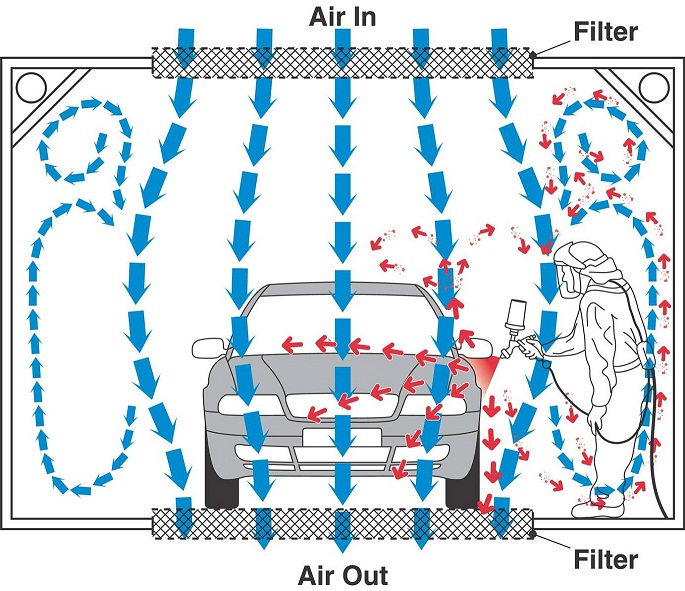
For many years, materials containing isocyanate have been the single biggest cause of occupational asthma in the UK. Vehicle paint sprayers are 80 times more likely to develop occupational asthma than workers in other industries. This is caused by the inhalation of the fine paint mist that is generated when paint spraying.
There is a requirement for the measurement and display of "clearance times" for spray booths / rooms set by the HSE and the Motor Vehicle Repair (MVR) to meet the requirements of Control of Substances Hazardous to Health (COSHH).
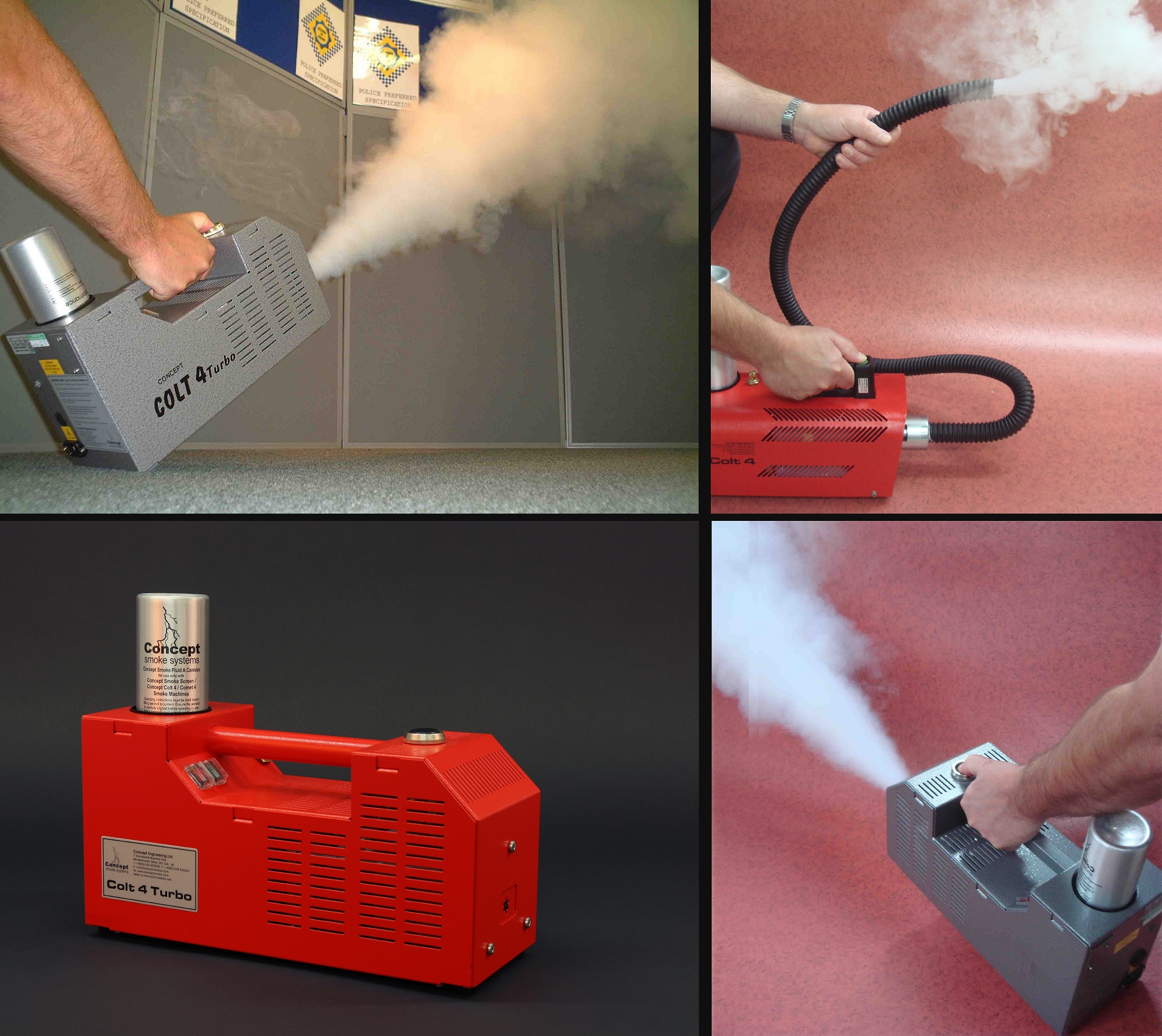
Concept recommend the use of the Colt 4 smoke machine. It generates a dense, persistent smoke with a hang time of 1.5 hours (Approx.). Unlike typical entertainment smoke machines where the resulting effect will disperse within a few minutes, the Colt 4 allows users to test spray booths extraction systems accurately. This unit will leave no measurable residue / contamination unlike entertainment fog machines.
The Colt 4 can be used when disconnected from mains power supply for full portability.
The Health and Safety Executive, the Health and Safety Laboratory (HSL), major insurers and inspection bodies routinely use Concept Colt 4 artificial smoke to “see” the air movement created by various processes and therefore highlight areas of concern around those activities.
For example, artificial smoke is commonly used to assess clearance times within spray booths or cabins so that employers can ensure that effective ventilation systems are in place and workers are aware of the importance of always wearing air-fed breathing apparatus.
Clearance time is measured by a smoke generator being used to fill the booth / room with smoke and recording the time the extraction system takes to clear the area.

It is recommended that a clearance time test should also be completed every 14 months.
For some of these applications, smoke can be passed through flexible hose, essentially giving the operator a wand out of which smoke can be produced.
It is normally beneficial to produce a highly persistent smoke (so that it movement can be traced over long distances or over a long period of time). Should the need arise however, quickly dispersing smoke fluid is available. This would normally be limited in use to highlight things such as the capture bubbles around LEV systems. It should not be used for clearance testing, as the fast evaporation of this sort of smoke can lead to false impressions as to the effectiveness of the ventilation system.
Concept also recommend the Spirit 900 smoke generator for filling larger spray booths. The water based smoke from the Spirit 900 also has a hang time of over 1.5 hours.
Our Users Say:
"The professional Colt 4 Turbo was superior to the other commercial fog machines; it produced the most smoke in a given time; produced the thickest fog; and was capable of smoke production when disconnected from the mains!" - HSL
For more information about LEV testing, please visit the UK's Health and Safety Executive official website, feauturing several video clips using Colt 4 smoke:

Hire Concept's smoke machines for Spray Booth / LEV testing
Concept Recommends
For Persistent Smoke -
For Quickly Dispersing Smoke -

Demonstration movies
Concept Air TraceColt 4 with hose
Mini Colt 4
Downloads

Latest News
> view all articlesColt 4 Twin Turbo - New Product

Concept Smoke Systems are one of the leading smoke machine manufacturers... Read more >
ESS 2015

Concept are pleased to be exhibiting and supporting the Emergency Servic... Read more >
> view allTestimonials
Warsash Maritime Academy
"We have always found that one of the most effective ways to recreate the sort of conditions caused by a fire, either on a ship or off-shore structure, is by adding safe, artificial smoke. Cadets sometimes think they can remember escape routes but when they are confronted with almost no visibility due to the thickness of the smoke, they realise just how disoriented you can become. The Academy has used Colt's for years now and we have always been more than happy with the way they perform and the service we receive from Concept Smoke Systems!"